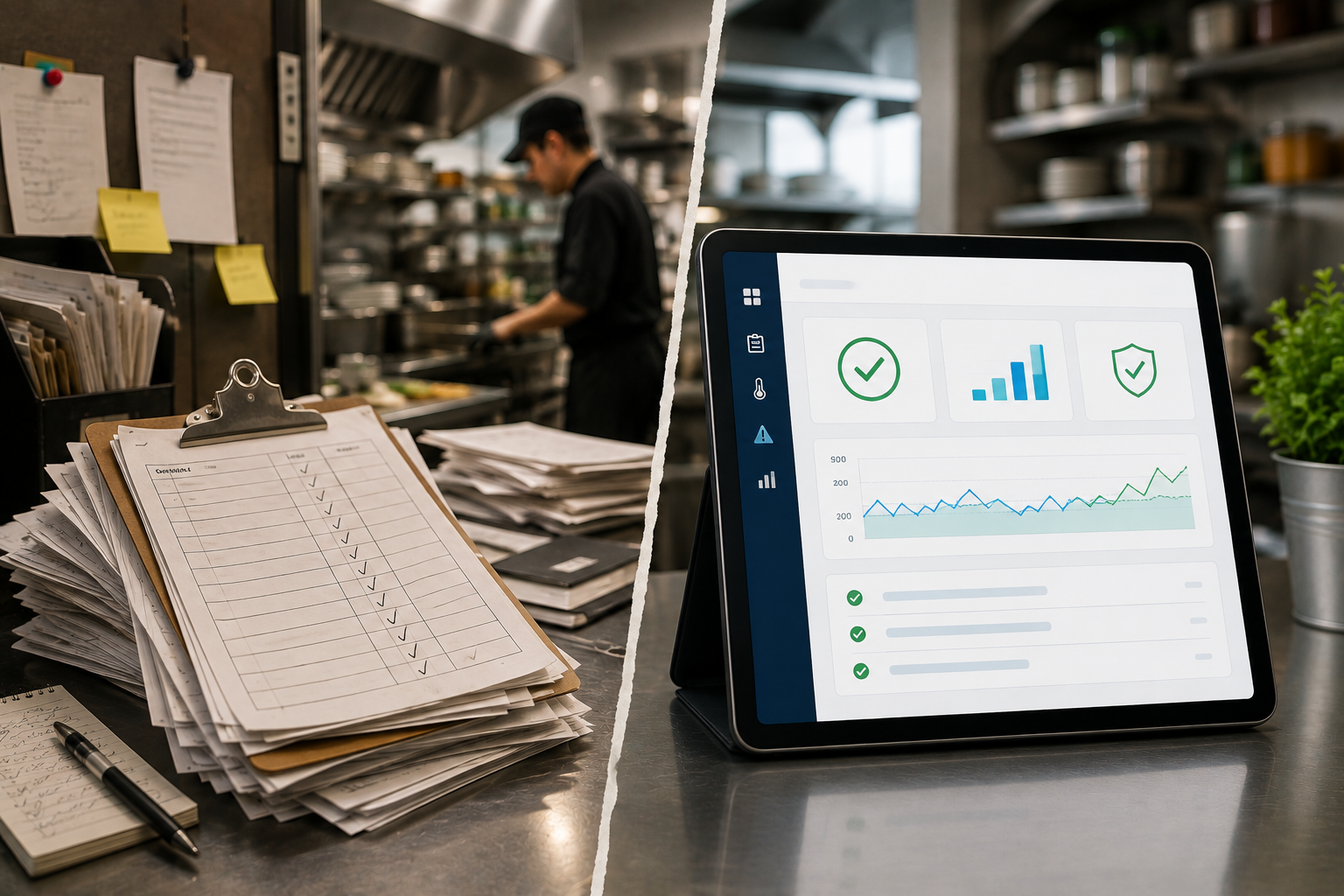
Paper checklists look inexpensive.
A stack of printed forms, a pen, and a clipboard may seem like everything a restaurant needs to manage daily food-safety tasks.
But the real cost of paper checklists isn’t the paper.
It’s the time, errors, and lack of visibility that come with them.
The Work Behind Every Checklist
Consider a typical restaurant.
Employees complete opening checks, temperature logs, cleaning schedules, closing procedures, and other operational forms every day.
Someone has to:
- Print the forms.
- Distribute them.
- Explain what needs to be completed.
- Collect completed sheets.
- Review them.
- File them.
- Find them when needed.
- Follow up on missing information.
Multiply that process across multiple locations, multiple shifts, and hundreds of operating days.
The administrative workload quickly adds up.
Paper Makes Problems Harder to See
A completed checklist doesn’t necessarily mean a problem was resolved.
For example, a temperature log might show that a refrigerator was outside the acceptable range.
But what happened next?
Was the food moved?
Was the equipment checked?
Was maintenance called?
Was the issue resolved?
A paper form may record the temperature but provide little visibility into what happened afterward.
Human Error Is Inevitable
Restaurant employees work in fast-paced environments.
During a busy shift, it’s easy to:
- Forget a checklist
- Miss a temperature reading
- Write down information later
- Lose a sheet
- Skip a task
- Forget to document corrective action
These aren’t necessarily employee failures. They’re often process failures.
A system that depends entirely on memory and paperwork will always have gaps.
The Management Problem
Paper also makes it difficult for managers to see what’s happening across the operation.
If a manager wants to know which locations missed temperature checks last week, they may need to manually review multiple forms.
If a recurring issue appears across several restaurants, identifying the pattern can take even longer.
Digital systems can make this information available much faster.
Automation Changes the Workflow
A digital food-safety system can help restaurants move from paperwork to actionable information.
Instead of simply recording a problem, the system can help create a process around it:
Check → Identify → Record → Correct → Verify
Managers can get better visibility into missed tasks, recurring issues, and corrective actions without searching through stacks of paper.
The Real Cost of Paper
Paper may have a low upfront cost, but the operational cost can be much higher.
Time spent completing, reviewing, organizing, and searching through paperwork is time that could be spent managing the restaurant.
For growing restaurant groups, the question isn’t simply:
“How much does paper cost?”
It’s:
“How much is our current process costing us in staff time, errors, and missed visibility?”
That is where digital food-safety management can make a meaningful difference.